
Your Wedding Music Guide: Choosing Between a Band, DJ, or Acoustic Act
Music is the one supplier decision guests actually feel. They might not remember the centrepieces or the canapés, but they will remember whether the dance floor was full, and whether they were on it.
The trouble is that “wedding music” isn’t one decision. It’s three or four little ones stitched together across the day: something for the ceremony, something for the drinks reception, something for dinner, and something for the party. A band, a DJ and an acoustic act each do some of those jobs brilliantly and others not at all — and the right answer for your wedding depends on your budget, your guests, your venue and the kind of night you want.
Here’s an honest guide to all three, what each costs, where each shines, and how the best weddings often combine them.
First, Map the Music Across Your Day
Before you choose who, work out when. A typical wedding day has four distinct musical moments, and they have completely different needs.
The ceremony. Quiet, emotional, structured. You need a processional (walking down the aisle), something for signing the register, and a recessional (walking back out, married). This wants intimacy, not volume.
The drinks reception. Background atmosphere while guests mingle on the lawn or in the garden. Live and unobtrusive is the dream — something people talk over rather than stop and stare at.
The wedding breakfast. Often no live music at all, or very soft background. This is when speeches happen, so you need the room to be hearable.
The evening party. The big one. This is what most of your music budget goes toward, and it’s where the band-vs-DJ-vs-acoustic question really bites.
Once you see the day this way, you stop asking “band or DJ?” and start asking “what do I want for each part — and can one act cover more than one moment?”
The Live Band
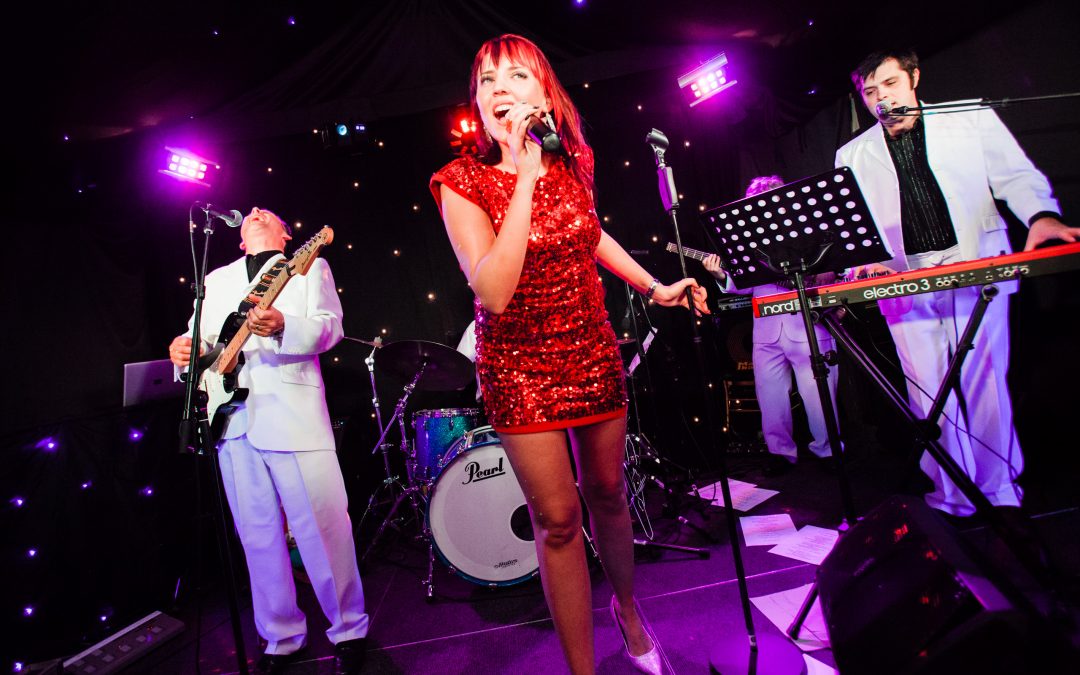
A live band is the showstopper. Nothing matches the energy of a great function band when the floor is full and the brass section kicks in.
What they’re brilliant at: Peak-energy evening parties. A skilled band reads the room, builds sets, takes the crowd up and brings them down, and creates moments a playlist simply can’t. The visual spectacle of live musicians is part of the entertainment in itself.
Atmosphere: High-energy, communal, celebratory. A band turns the evening into an event rather than background.
What to watch for:
- Cost. The most expensive option by some margin. A good 4–6 piece function band in the South East typically runs well into four figures. More members, more cost.
- Set breaks. Bands play in sets — usually two 45-minute sets with a break between. You’ll need recorded music or a DJ to cover the gaps, or the dance floor empties.
- Space and power. Bands need room to set up and enough power for amps and PA. Worth checking with your venue early.
- Repertoire fit. A soul-and-funk band is a different night from an indie-rock band. Match the band’s genre to your crowd, not just your own taste.
- Volume. Live bands are loud. In a single-room venue that’s part of the magic — but it means the music is the room once they start.
Best for: Couples who want the evening to be a proper, high-energy live event and have the budget to make the band the centrepiece.
The DJ
The wedding DJ is the workhorse — and a genuinely good one is worth their weight in gold. Forget the cheesy stereotype; modern wedding DJs are skilled crowd-readers who can play anything from Motown to garage to your nan’s favourite singalong.
What they’re brilliant at: Range, flexibility and stamina. A DJ can play continuously for hours with no set breaks, pivot instantly when the floor needs a lift, take requests, and cover every genre and decade in one night. Want Sinatra at 8pm and drum & bass at 11pm? A DJ does both.
Atmosphere: Flexible — can be subtle and classy or full-on club energy depending on what you want and how the night’s going.
What to watch for:
- Personality matters. The best DJs are invisible when they should be and commanding when they need to be. The worst over-talk on the mic. Always ask to see them work, or get a strong personal recommendation.
- It’s less of a visual spectacle. One person behind a console doesn’t have the wow-factor of a live band. Good lighting helps enormously here.
- The cheese risk. A weak DJ defaults to the same tired wedding playlist. A great one tailors it to you. The difference is night and day — vet carefully.
Cost: Significantly less than a band — usually the most budget-friendly of the three for a full evening of music. That saving is real and worth weighing against the spectacle of a band.
Best for: Couples who want maximum musical range and continuous energy for the whole night, or who’d rather put the band-level budget toward something else.
The Acoustic Act
A solo singer-guitarist, a duo, or a small acoustic ensemble. This is the most underrated category — and often the most versatile across the daytime parts of your wedding.
What they’re brilliant at: Ceremony, drinks reception and dinner. An acoustic act creates warmth and atmosphere without dominating the room. They’re perfect for the moments when you want live music people can talk over — the lawn drinks reception, the wedding breakfast, the gentle build of the afternoon.
Atmosphere: Intimate, romantic, relaxed. The sound of a single beautiful voice and a guitar on a summer lawn is hard to beat.
What to watch for:
- Not built for the late party. One acoustic act rarely sustains a packed midnight dance floor on its own. They’re a daytime and early-evening force, not a 1am one.
- Range limits. Gorgeous for atmosphere, less so for getting 100 people dancing to bangers.
Cost: Generally the most affordable of the three, especially for a solo act — though string quartets and larger acoustic ensembles climb in price.
Best for: The ceremony, drinks and dinner portions of any wedding — and the best-value way to add genuine live music to your day.
The Combination Most Couples Land On
Here’s the secret the suppliers know and couples figure out late: the best weddings rarely pick one. They layer.
The most common winning formula looks like this:
- Acoustic act for the ceremony, drinks reception and dinner — warm, live, affordable, atmospheric across the whole afternoon.
- DJ for the evening party — continuous, flexible, covers the full night with no set breaks.
Or, for a bigger budget:
- Acoustic act for the day.
- Band for the main evening party.
- DJ to cover the band’s set breaks and take the party past midnight.
Some acoustic acts and bands offer a “DJ in the breaks” service, which neatly solves the set-break problem from one supplier. Worth asking.
The point is to match each act to the moment it does best, rather than asking one act to carry the whole day.
How Your Venue Shapes the Decision
This is the bit couples often miss — your music choice and your venue are linked.
In a venue where the bar, dining and dance floor are spread across multiple rooms, your music has to fight to pull people together, and a band in one room can leave the bar crowd out of earshot. In a single-room venue, the music is the room — whatever you choose carries the whole party because everyone’s in it together.
That’s exactly why we’re so particular about keeping dining, dancing and the bar in one barn at Selden Barns. The dance floor sits on its own raised platform alongside the main room, with the band or DJ already set up and ready to go — so the moment speeches end and the first dance is called, the music strikes up and the party flows on without a pause. No dead half-hour while a band lugs gear into a separate room. No bar crowd who can’t hear the music. Whatever act you choose, the whole room feels it.
It also means you only need to sound-check and set up in one space, which most bands and DJs love — and which sometimes works in your favour on price.
Practical Questions to Ask Any Act
Whoever you’re considering, ask these before you book:
- Can we see you perform live, or watch full-length video? Not a 30-second showreel — a real set.
- What happens during breaks (for bands) — do you provide music, or do we need a separate solution?
- How much space and power do you need? Check this against your venue early.
- What’s your setup and breakdown time? Affects your timeline.
- Do you take requests / a do-not-play list? You’ll want both.
- What’s included — PA, lighting, microphones for speeches?
- Do you have backup if a member is ill, or PA equipment fails?
- Are you insured and PAT-tested? Many venues require this — we do.
- What do you wear? Should match the formality of your day.
- First dance — can you learn a specific song if it’s not in your repertoire?
A Few Final Tips
Book early. The best bands and DJs in Sussex get reserved 12–18 months out, especially for peak Saturdays. If a particular act matters to you, lock them in.
Consider midweek. Top entertainment acts often charge noticeably less for midweek dates — one of several reasons couples are choosing them. More on that in our midweek vs weekend weddings guide.
Give them a steer, not a script. Share a do-not-play list and a handful of must-haves, then trust a good act to read the room. Over-programming every song usually backfires.
Think about your guests, not just yourselves. Your taste matters, but a floor full of happy guests of all ages matters more. The best acts play for the room.
See the Space for Yourself
The easiest way to picture your band, DJ or acoustic act in action is to stand where they’ll play. Come and see how the Main Barn works — where the dance floor sits, where the act sets up, and how the whole evening unfolds in one room.
Book onto our next open evening →
We’re always happy to recommend bands, DJs and acoustic acts who know the venue well — just ask.