
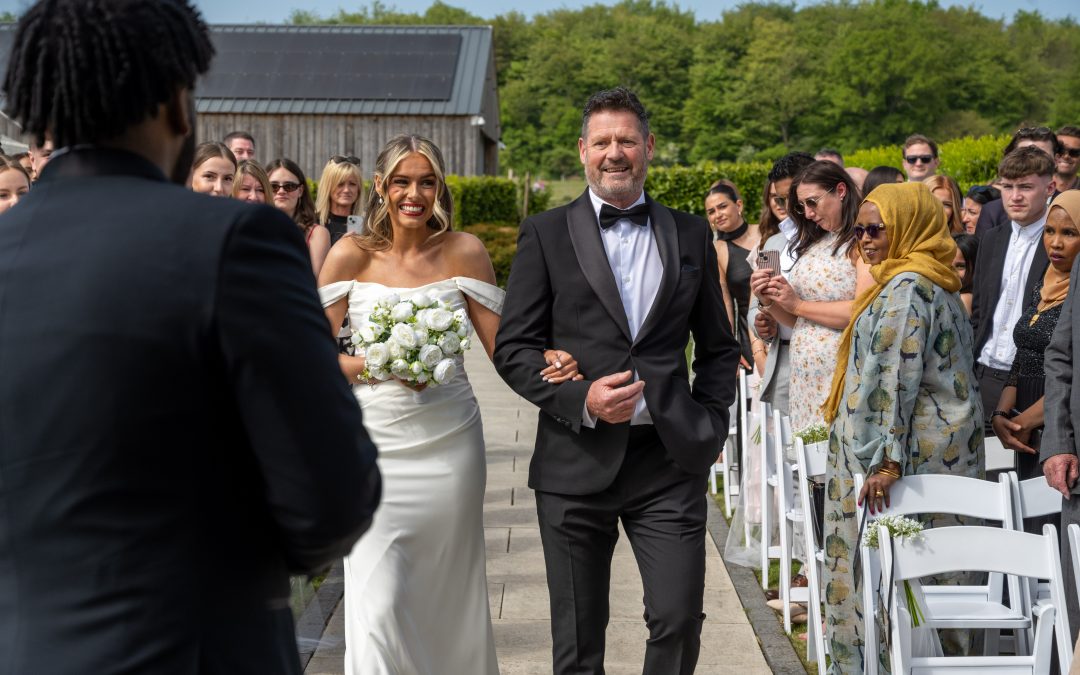
Civil Wedding Ceremonies at Selden Barns: How the Legal Side Actually Works
Somewhere between “we’re engaged” and “we’ve booked the venue,” every couple ends up in the same Google rabbit hole. Do we need a registrar? Do we have to give notice somewhere? How far in advance? What paperwork do we need? Is the day legally a wedding if we do it outside?
The legal side of a UK wedding has a reputation for being baffling. In practice it’s quite straightforward — there are just a small number of steps that have to happen in a specific order. This post walks through them in plain English, with how it actually works at Selden Barns.
We’re a licensed venue for civil marriages and civil partnerships in West Sussex, which means the legally binding ceremony can happen here, on the day. No separate trip to the register office. No two ceremonies. Just your one wedding day, in the place you’ve chosen.
The Bit Most Couples Get Wrong
The most common piece of confusion is this: people think they have to be married at a register office to be legally married. They don’t.
In England and Wales, a marriage or civil partnership is legally binding when it’s conducted by a registrar at a licensed venue, or by an authorised person at a registered religious building. Selden Barns is a licensed venue. Our three ceremony spaces — the lawn, the pergola and the indoor ceremony barn — can all host the legal ceremony. There is no separate “register office bit” to do before or afterwards. You arrive engaged and you leave married, from the same place, on the same day.
The official version, in case it’s useful, is on the West Sussex County Council marriage and civil partnerships pages. What follows is how that maps onto a wedding here.
The Six Steps, in Order
The process is shorter than it looks. There are six pieces, and you’ll move through them in roughly this sequence over the course of your engagement.
Step 1: Check You’re Both Eligible
The basic legal requirements for marriage or civil partnership in England and Wales are straightforward — you both need to be 18 or over, free to marry (i.e. not already married or in a civil partnership), and not closely related. If you’ve been married before, you’ll need the original or certified copy of the decree absolute or final order, and if your previous spouse died you’ll need their death certificate. If you’re not a British or Irish citizen, there are some additional steps under the immigration rules; the GOV.UK page on who can get married is the clearest summary.
For the overwhelming majority of couples, this step is a five-minute read and a quick confirmation that everything’s in order.
Step 2: Decide Where and When
This is the bit that does take some time — and it’s the bit we can actually help with. You choose your venue, the date and the part of the day you want the ceremony to happen. Selden Barns runs ceremonies through the year, with three spaces available depending on the weather and what you’ve pictured. There’s a fuller guide to the ceremony spaces here if you want to compare them properly.
Once you’ve held a date with us, the next two steps move in parallel.
Step 3: Book the Registrar
This is the one new couples find slightly odd, because it’s a separate booking from the venue. You book the registrar directly with West Sussex Registration Service for your wedding date — and you need to do this before you can give notice (Step 4), because the notice paperwork includes the date and venue of the booked ceremony.
The registrar takes care of the legal side of the day. They’ll meet you in advance to go through the ceremony script, what you’re allowed to include legally, and what personal touches you want — readings, vows, music. The fee for the registrar is paid separately to the council, on top of the venue.
You can start the registrar booking on the West Sussex County Council ceremony booking page. If you’re not sure where to start, ask your coordinator at Selden Barns — we’ve done this with couples hundreds of times and can talk you through the order of operations.
Step 4: Give Notice (The 29-Day Rule)
This is the legal step that catches a lot of couples by surprise. You and your partner each need to attend a face-to-face appointment at a register office in the area where you live, signing a legal paperwork that declares your intention to marry. This is called “giving notice.”
A few things to know about it:
- You give notice in the area where you live, not where the wedding is. So if you live in London and you’re marrying in Sussex, you each give notice at your London register office.
- You each give notice separately, in person — even if you live at the same address.
- The legal minimum between giving notice and the wedding is 29 days. The notice is then valid for 12 months. In practice this means you can give notice as far in advance as you like, up to a year, but no later than 29 days before the wedding.
- You’ll need photo ID and proof of address. Bring more than you think you’ll need — the requirements vary slightly depending on your nationality.
- The ceremony must already be booked before you can give notice, because the notice paperwork includes the venue and date.
Most couples give notice somewhere between six and ten months out. The detail and the appointment booking are on the West Sussex Council giving notice page.
Step 5: Plan the Ceremony Itself
This is the lovely bit. Once the legal paperwork is in motion, you can shape what the ceremony will actually feel like.
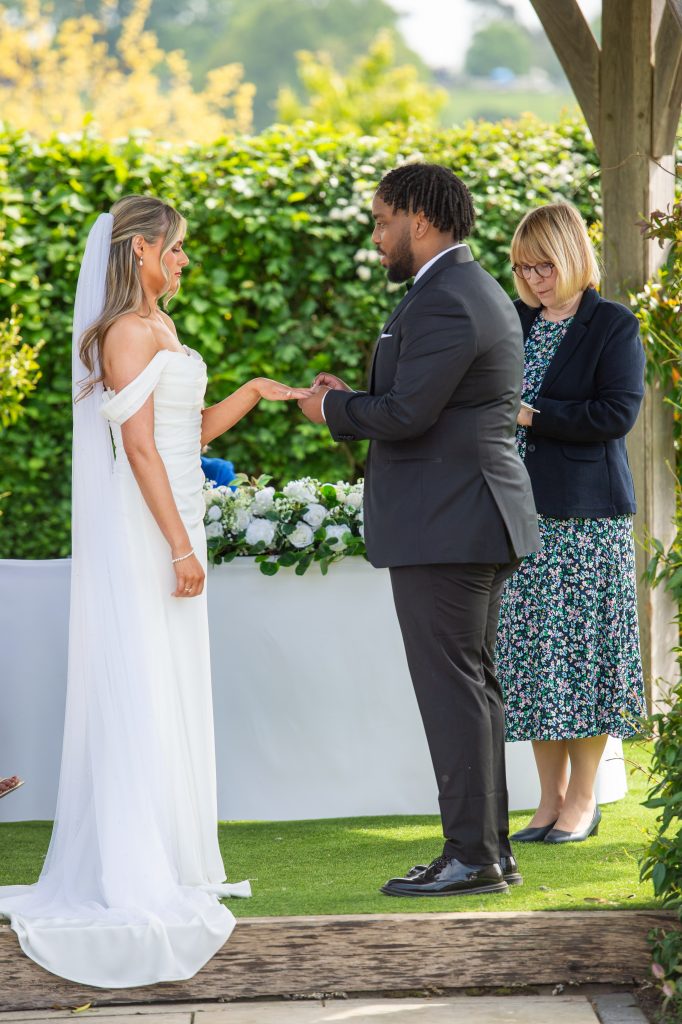
The registrar handles the parts that are legally required — the declaratory and contracting words, the signing of the schedule. Everything else is yours. You can add personal vows, choose readings (non-religious only, since this is a civil ceremony), pick the music for walking in, signing the register and walking out. You can include children, parents, friends in the ceremony in various ways.
Roughly two to three months before the wedding, you’ll fill in a “ceremony choices” form for the registrar, which captures the music, the readings, the names of the witnesses (you need two), and any custom vows or touches you’d like to include. The registrar will then put together the script and meet with you to go over it.
If you’d like a humanist ceremony, a wholly bespoke set of vows that don’t fit the civil framework, or a religious element — none of those can happen inside the legal civil ceremony itself. They have to be in a separate celebratory ceremony either before or after the legal bit. Plenty of couples do this — they have a humanist or interfaith ceremony at the venue, and pair it with a short legal registry visit a day or two earlier. We can talk you through how it fits together.
Step 6: After the Ceremony
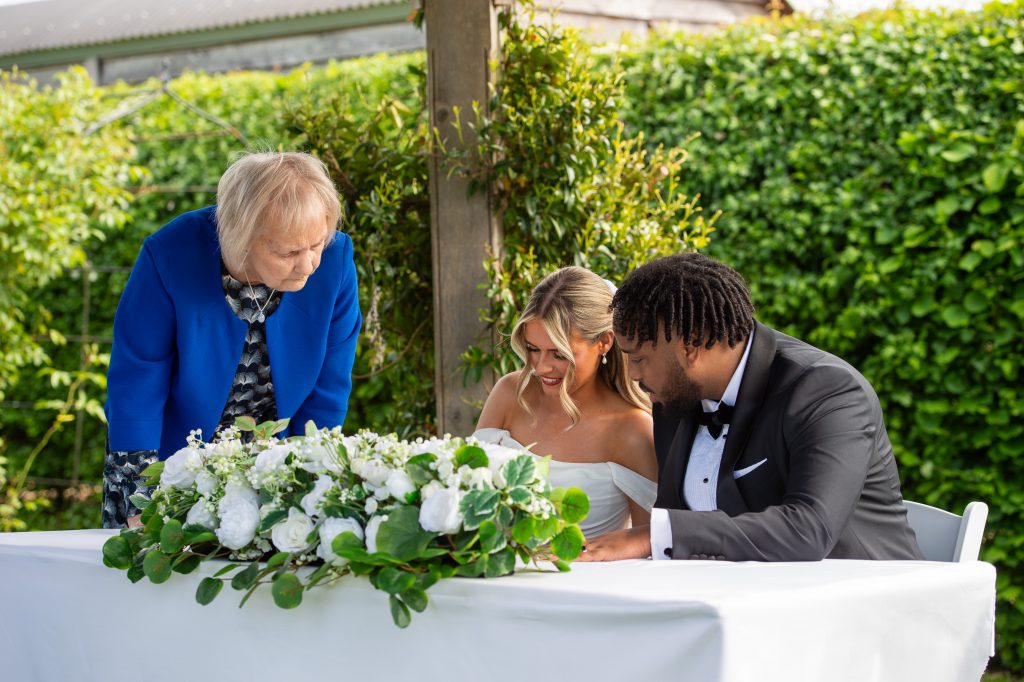
The legal moment is when you sign the marriage schedule with your registrar and witnesses. From that moment, you are legally married. Your registrar will send the schedule to the register office, who’ll register the marriage and issue your marriage certificate.
You’ll need to order any extra copies of the certificate separately — for name changes on passports, banks, DVLA and so on. The certificates page on West Sussex Council explains the cost and the process.
If you have children together from before the wedding, their birth certificate can be re-registered with both parents’ names if you want — that’s a separate process via the council. Not relevant to most couples, but worth knowing it exists.
What Can and Can’t Be in a Civil Ceremony
A civil ceremony in England and Wales is, by law, non-religious. That means:
Allowed: non-religious readings (poetry, prose, philosophy, your own words), instrumental music with no religious lyrics, personal vows alongside the legal ones, the involvement of children, parents and friends, ring exchanges, hand-fasting, unity candles or sand ceremonies done in a non-religious form, and a lot of personalisation around the legal core.
Not allowed in the legal ceremony: religious music with religious lyrics, hymns, prayers, religious readings, religious officiants taking part. If religion matters to you, you can have a separate religious ceremony at a registered religious building — many couples do.
If your heart is set on a humanist celebrant — a real, named celebrant rather than a registrar — that’s worth knowing about up front. Humanist ceremonies aren’t currently legally binding in England (though they are in Scotland and Northern Ireland). The way to have a humanist wedding here is to do the legal bit at a registry office on a different day, and have the celebrant-led ceremony at Selden Barns. It works beautifully, and we host quite a few couples doing it this way.
“We’re Marrying Elsewhere and Celebrating at Selden Barns”
This is a common enough setup that it’s worth covering directly. Plenty of couples have done the legal bit somewhere else — a tiny registry office wedding, a wedding abroad, a religious ceremony in a family church — and want to bring everyone together for the celebration here.
Our evening reception package is built for exactly this. It assumes the legal ceremony has happened elsewhere and gives you a proper evening at the venue — drinks, food, dancing, the lot — without paying for a full-day venue hire you don’t need.
If you’ve married legally abroad, your marriage will still be recognised in the UK as long as it was conducted in accordance with the law of the country it took place in. The GOV.UK page on getting married abroad covers the paperwork side.
Same-Sex Marriages and Civil Partnerships
The legal process for same-sex marriage and civil partnership is the same as for opposite-sex marriage, and Selden Barns is licensed for both. We’ve covered the specifics of same-sex weddings and civil partnerships in Sussex in a separate post, which goes into more detail on the choices and the language around it.
A Few Common Questions
Can the ceremony happen outdoors? Yes. Outdoor civil ceremonies at licensed venues became fully legal in England and Wales in 2022, and our outdoor lawn and pergola are both available for the legal ceremony. If the British sky doesn’t cooperate, we move undercover.
How long is the ceremony? Typically 20 to 30 minutes. Longer if you’re adding readings, music interludes or extra vows.
How many witnesses do we need? Two, named and present at the ceremony. Most couples use their parents, best people or close friends.
Can we change our minds about readings or music after the ceremony choices form is in? Usually yes, within reason — talk to the registrar. Big changes are easier earlier than later.
Can the registrar marry us anywhere on site? They marry you in a licensed space, which at Selden Barns includes the three ceremony spaces. Anywhere else (a corner of the lawn, in the gardens) isn’t legally licensed, though you can absolutely take the photographs there afterwards.
How much does the registrar cost? The fees are set by West Sussex County Council and the figures are on their ceremony fees page. They vary by day of the week and whether it’s a peak or off-peak time.
Does the registrar come with the venue? No — they’re a separate booking with the council, and a separate fee. We’ll help you align the timing.
How We Help
The legal side isn’t something we handle for you — the registrar booking and the giving of notice are your responsibility, and we couldn’t do them for you even if we wanted to. What we can do is talk you through the order of operations, line up the dates so the ceremony and the notice work cleanly together, and answer the questions you didn’t know to ask before you started.
Your coordinator at Selden Barns has helped a lot of couples through this process. We know the registrar team well. We know what catches people out. We know which questions you need to think about now and which can wait.
If you’re stuck on any of it, just ask.
Come and See the Ceremony Spaces
The fastest way to make all of this feel less abstract is to stand in the room where you’ll say your vows. The lawn, the pergola, the indoor ceremony barn — all three are open for you to walk through at our open evenings, or on a private tour at a time that suits you.
Book onto our next open evening →
Email us for help with the process →
Once you’ve stood in the space and seen how a wedding day actually flows here, the legal side becomes the small part it should be — a thirty-minute exchange of vows at the centre of one of the loveliest days of your life.