
How to Write Your Wedding Vows: A Guide for People Who’ve Never Written Anything Before
At some point between booking the venue and buying the outfit, most couples decide they’re going to write their own vows. It sounds lovely at the point of the decision, and it stays lovely right up until about six weeks before the wedding, when you sit down at your kitchen table with a blank page and realise you’ve never written anything more heartfelt than a birthday card message in your life.
The good news is that writing your own vows is far more achievable than most people realise. It’s not a poem. It’s not a speech. It’s not the wedding version of a Best Man’s roast. It’s just a short, honest, well-thought-out promise to the person you love — and there are quite a few practical things you can do that turn a blank page into a finished set of vows you’ll actually enjoy saying.
This is a guide for people who’ve never done anything like this before, and don’t want to. If you’re intimidated by writing anything longer than a text message, this post is for you. Here’s how to write your wedding vows without losing sleep about it.
Should You Even Write Your Own?
Worth answering this before you commit to the whole project.
There’s absolutely nothing wrong with using the standard civil-ceremony vows. Millions of couples do, they’re beautifully written, they’re time-tested, and reading them out at your ceremony doesn’t make you love your partner any less. If the whole idea of writing personal vows fills you with dread rather than excitement, don’t do it. You’ll enjoy the ceremony more without it hanging over you.
The middle option, which more couples than you’d think choose, is to use the standard legal vows with one or two personal additions — a single sentence each of what you promise specifically, or a short line of what you love. That gives you the personal touch without an eight-week creative writing project.
Full personal vows work best when both of you are on board, both of you have time to write them properly, and neither of you is dreading it. If one partner desperately wants to write theirs and the other is stalling, agree that only one of you will — asymmetry in vows is fine, and it’s a lot better than one person delivering brilliant vows and the other reading a half-hearted paragraph they wrote on the way to the ceremony.
How Long Should They Actually Be?
This is the question that gets answered wrong most often, so let’s put a proper number on it.
Aim for 60 to 90 seconds of speaking time. That’s roughly 150 to 250 words.
Any shorter and it feels rushed and unfinished. Any longer and you’ll lose the room, and the more emotional passages will land less well because guests have already started thinking about the drinks reception. Two minutes is the absolute upper limit. Anything more is a speech, not a vow.
The two-minute rule matters because you’re saying them at the front of a ceremony that has to hit certain legal beats and stay coherent as a piece of ritual. A three-minute personal vow after another three-minute personal vow tips the whole thing off balance. Keep them short. Cut ruthlessly.
The Structure That Actually Works
Here’s a five-part structure that turns “write your own vows” from an impossible task into a fill-in-the-blanks exercise. You don’t have to use it — plenty of great vows don’t follow it — but it’s a reliable framework if you’re stuck.
1. Open with something specific. A memory, a moment, a small thing. Not “from the moment I met you.” Something concrete — the day you knew, the sentence they said, the small detail that stuck.
2. Say what you love about them. Two or three specific things, not a generic list. Specific always beats generic. “You laugh at your own jokes before finishing them” is worth ten of “you make me laugh.”
3. Acknowledge the reality. A moment of honesty about what marriage is — the hard bits, the ordinary bits, the fact that it isn’t going to be endless perfection. A single sentence is enough. It grounds the whole thing.
4. Make your actual promises. This is the vow bit. Three or four things you promise. Try to make at least one of them small and specific to you as a couple, not just the standard “to love and honour.”
5. Close with a forward-looking line. Where you’re going, what you’re excited about, what you can’t wait for. Short. Warm. Ends on a note the room can land on.
That’s roughly 150-200 words if you keep each section tight. Twelve to fifteen sentences in total. Very doable.
The Actual Writing Process
The reason most people can’t write their vows isn’t a shortage of feeling. It’s that they’re trying to write the finished version straight away. Nobody writes anything worth reading like that.
Here’s a process that works, spread over two or three sittings across a couple of weeks.
Session 1: Lists, not sentences. Sit down with a notebook or a document. Don’t try to write vows. Just answer these prompts as bullet points — as many as you want, no filter:
- The moment I knew you were the one
- The small thing you do that I love
- The thing about you that surprised me
- The moment in our relationship I remember most
- The way you make our life easier
- The thing you’ve taught me
- What I’m most excited about in our marriage
- The promises I want to make out loud
Don’t edit. Don’t polish. Just get everything down. Give yourself an hour and step away.
Session 2: The rough shape. A few days later, come back to the list. Pick out the two or three specific things that feel most true. Not the most romantic-sounding — the most true. Group them roughly into the five-part structure above. Write the whole thing as prose, badly, without worrying about how it sounds.
Session 3: Cut and shape. A week later, come back with fresh eyes. Read what you wrote. Cross out the parts that feel generic. Keep the parts that feel like you and only you. Rewrite each section tighter. Read it aloud.
This is the bit couples skip and shouldn’t — cutting is what makes vows good. First drafts are always too long, too general, and too self-conscious. The version that will make your partner cry at the altar is the one you cut down to the true parts.
What to Include
The vows that land hardest have a few things in common.
Specifics, not adjectives. “You are kind” isn’t as strong as “You always ask the taxi driver about their day.” “You are patient” isn’t as strong as “You have never once, in six years, been annoyed at me for how long I take to get ready.” Concrete detail beats vocabulary every time.
A moment. One memory that captures the two of you — a specific evening, a specific journey, a specific mistake you both laugh at. It grounds the whole vow in something real that only your partner will recognise.
A promise that isn’t the standard one. Alongside the usual “to love and support” promises, add one that’s small and specific. To always laugh at their jokes. To always make the tea in the morning. To never talk about work in bed. Something that shows you know them.
An acknowledgement of imperfection. A single sentence that admits marriage isn’t a Disney film — that there’ll be arguments and sulking and days you drive each other mad — is what makes the rest of the vows feel earned rather than aspirational.
The room, gently. Somewhere near the beginning, a quick nod to the people in front of you. “In front of everyone we love” or similar. A small thing, but it pulls the room into the moment.
What to Avoid
The vows that land badly usually do so for one of these reasons.
Inside jokes only two of you understand. If half the room has to guess what you’re talking about, you’ve lost them. A single knowing reference is charming. Three is exclusionary.
Anything that could sound like a joke about your partner. The line that seemed funny in your head can land oddly at the front of a wedding. Read it back and ask honestly — could this be misinterpreted as a dig?
References to exes, past relationships, or “before you I was lost.” Even meant as compliments, they leave a strange note. Skip them.
Sentences that would age badly. Any political reference, any joke about current news, any pop-culture line that will look weird in five years’ time when you rewatch the wedding video.
Adjectives you’d use in a card to your grandma. “Wonderful,” “amazing,” “the best.” True but generic. Reach for something more specific.
Weepy passages if you’re a nervous public speaker. If you know you’ll cry, plan for it — a shorter vow you can get through is better than a longer one you can’t finish. There’s no shame in cutting a section because you know you won’t survive saying it.
Should You Share Them Beforehand?
There are three schools of thought and none of them is wrong.
Share fully. You read each other’s vows in advance and can edit for length, tone and coordination. This is the safest option, especially if you’re worried one of you will write something the other might find awkward. Some couples find it a lovely private moment in the week before the wedding.
Agree the structure only. You decide together on length, tone (funny vs serious) and whether you’ll both add personal promises or use the standard legal vows with an addition. Then you write independently. This is the middle ground most couples land on.
Fully blind. You both write independently, don’t compare notes, and hear them for the first time at the ceremony. The most romantic option, and by far the highest-risk. Only recommended if you’re absolutely sure you know each other well enough to write with a similar tone.
The compromise: write independently, then swap a week before the wedding for a quick sanity check on length and to catch anything that might not land the way you meant it. Best of both worlds.
Practising and Delivering
Once they’re written, the last job is being able to say them without falling apart. A few practical things.
Print them big. Large font, printed on a card or a piece of nice paper. Not a folded A4 sheet. You’ll be holding this in front of a hundred people; make it easy to read.
Read them aloud, standing up. Do this multiple times in the week before. Sitting-and-reading in your head is completely different from standing-and-speaking. You’ll find the sentences that don’t scan aloud, and you can adjust.
Time yourself. Read them at the pace you’ll actually deliver them (slower than conversation). If they run more than 90 seconds, cut.
Practise the emotional bits. The parts that make you cry when reading in your kitchen will make you cry more at the altar. Rehearse those specifically until you can get through them.
Bring a spare copy. In case you drop the card, in case the printing smudges, in case you leave them in the getting-ready room. Your best man, chief bridesmaid or coordinator can hold the spare.
Take a breath before you start. Small thing, big difference. A single pause at the top settles you and sets the tone for the delivery.
The Legal Bit, Briefly
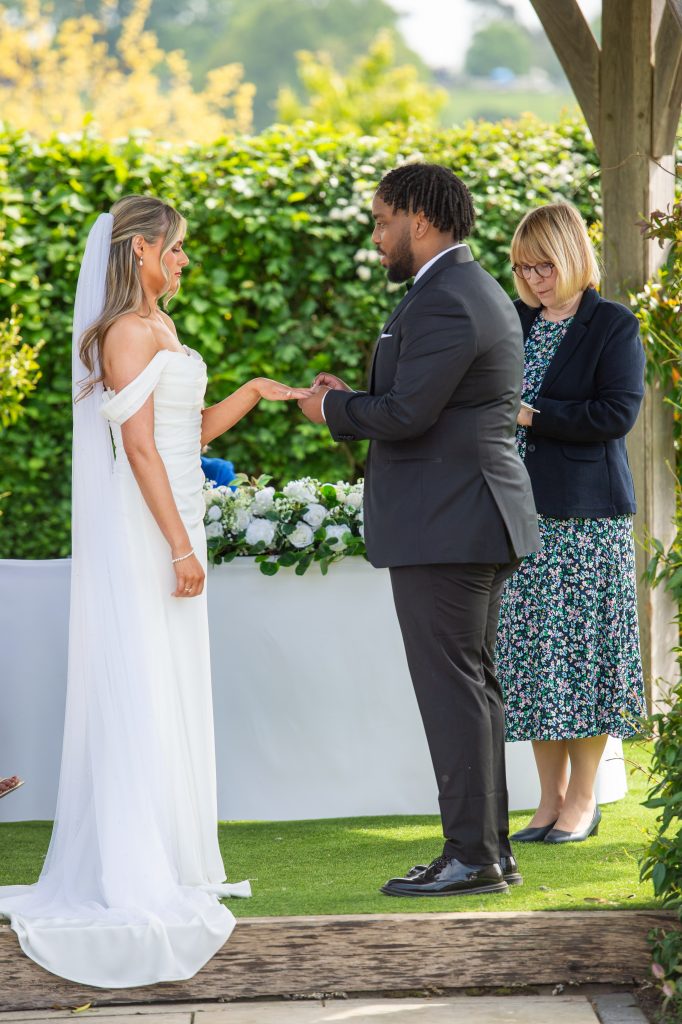
Worth knowing: your personal vows are added alongside the legal ceremony, not instead of it. The registrar has legally required declarations and contracting words to say, and your personal vows sit around those.
At Selden Barns, we work regularly with the West Sussex Registration Service, and they’re happy to include personal vows as long as they’re not religious in nature and the couple has told them in advance what they’d like to include. The full civil ceremony process is covered in more depth in our separate post.
You’ll typically send your personal vows to the registrar in the “ceremony choices” form around two to three months before the wedding, so they can build them into the ceremony structure. If you want to keep them entirely to yourself and read them from a card without the registrar seeing, that’s usually possible too — just confirm with them when you have your pre-wedding meeting.
A Small Piece of Reassurance
The vows you write are not being marked. Your partner is not comparing them to someone else’s Pinterest-perfect version. Your guests are not literary critics.
Everyone at a wedding is on your side. The bar for a moving vow is much lower than the internet makes it look. Any two people standing at the front, promising something honest in their own words, will make the room cry. The vows you write in your kitchen next Tuesday evening will be exactly right, because they’re yours.
If you’re planning your ceremony at Selden Barns and want to walk through the three ceremony spaces where you’ll be saying them, our open evenings and private tours run throughout the year.
Book onto our next open evening →
Write them early. Cut them ruthlessly. Read them aloud. And trust that the honest, specific version — the one that took you three sittings and felt slightly awkward to write — will be the one that lands.