
Small Wedding Venues in Sussex: Micro Weddings at Selden Barns
There’s a quiet shift happening in how couples are choosing to get married, and it’s been going on for a few years now. More and more couples are deciding that the version of their wedding they actually want isn’t the 120-guest, three-course, multi-cousin extravaganza their parents had. It’s something smaller. Closer. About thirty people they actually love.
The trade name for this is a “micro wedding,” somewhere usually defined as anywhere between roughly 10 and 50 guests, and the difficulty isn’t deciding you want one. The difficulty is finding a venue that actually works at that size. Most wedding venues are built and priced for large weddings, and a small wedding in a big venue can feel a bit like a dinner party in a cathedral — the food is the same, the people are the same, but the room itself never quite lets the day settle.
Micro Wedding, Small Wedding, Elopement: A Quick Distinction
Worth clearing up early, because the terms get used interchangeably and they shouldn’t be.
An elopement is usually two people, sometimes with a couple of witnesses, often with a registrar and not much else. The decision is about going small as a deliberate intimacy rather than as a venue choice.
A micro wedding is something different. It’s still a wedding — ceremony, vows, photographer, dinner, dancing, speeches, the whole shape of the day — but with somewhere between roughly 20 and 50 guests instead of 100-plus. Often dinner is around one long table rather than several rounds. There’s still a first dance, but it might be one guitar and 30 people rather than a six-piece band and a packed floor.
And a small wedding is anything that sits between those two — the family-only celebration, the second wedding done at a sensible scale, the couple who’d rather invite half as many and do it twice as well.
Why Smaller Weddings Don’t Work in Most Venues
It’s worth being honest about this because most couples find out the hard way.
A lot of wedding venues are built and operated for one size of wedding. Their main room is set up for 100 covers. Their pricing is built around 100 covers. Their team works at the scale of 100 covers. When you book it for 30 guests, you get a discount and a room that looks slightly empty, and on the day the team is mentally still hosting the 100-guest version with a smaller cast. The texture of the day suffers without anyone meaning it to.
The other problem is what happens before and after the meal. A small wedding in a large space tends to lose its drinks reception in the corners of the lawn, lose its dance floor to too much empty space, and lose the easy huddling-together that a small wedding really wants. The dance floor is the giveaway. Thirty guests in a room built for two hundred can’t shake the feeling of being a small group in a big space.
You can fix some of this with clever set-up. You can’t fix all of it. The honest answer is that some venues are properly suited to smaller numbers and most aren’t.
What Makes Selden Barns Work at Smaller Numbers
A few specific things about the venue make it work as well at 30 guests as it does at 100.
The first is exclusive use of the whole venue. It doesn’t matter how few of you there are — the entire place is yours for the day. There’s no other wedding next door, no shared bar, no scaled-down version of the experience for smaller bookings. You get the same lawn, the same barns, the same gardens, the same coordinator. The day has the same dignity whether there are 22 of you or 100.
The second is the way the main barn is set up. The dining table sits on one side, the dance floor on the other, the bar in between, with the spaces flowing naturally from one to the next. At a smaller number, that single-room layout closes in around your group rather than spreading thin across separate rooms. Twenty-five people around a long table in the centre of the barn, candles down the middle, doors open onto the grounds in the summer, fire lit in the colder months — it doesn’t feel sparse. It feels like dinner with everyone you love.
The third is the on-site accommodation. For a small wedding, this matters more than it does for a large one. At 30 guests, there’s a reasonable chance most or all of them could stay on site. Which means the day stretches naturally into the evening before and the morning after. You get a slow drink in the bridal cottage the night before. You wake up to coffee with the people who matter most. You’re not chasing taxis at midnight or saying goodbye to anyone too soon. The whole celebration runs at a different, slower tempo.
What a Small Wedding Day Actually Looks Like
Easier to picture if you have a real shape for it.
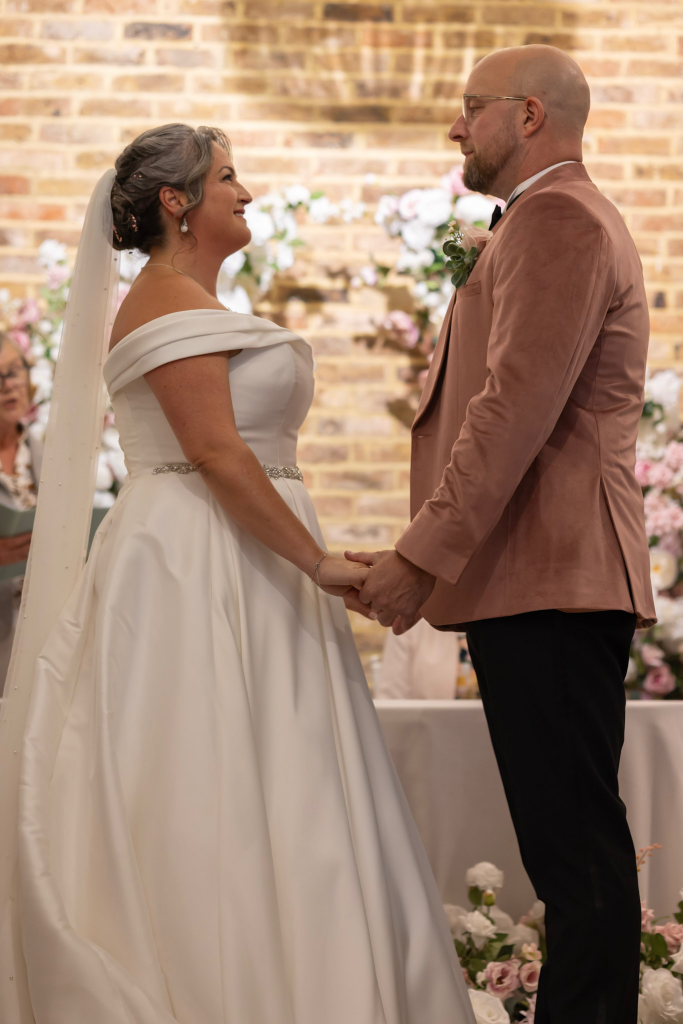
Most small weddings at Selden Barns run something like this. Hair and makeup happens in one of the cottages from late morning. The ceremony is at one or two in the afternoon, often outside on the lawn or under the pergola, with chairs in a closer half-circle than a full-scale wedding. Drinks happen on the lawn or in the garden, and because you’re a smaller group the canapés and fizz somehow feel more deliberate, with everyone talking to everyone.
Photographs are easier and faster at smaller numbers. Group shots that take 40 minutes at a 120-guest wedding take 10 here, and the couple portraits get all the time they should.
The wedding breakfast often happens around one long table rather than several rounds. Everyone can hear the speeches. The toasts feel different — closer, more personal, sometimes a bit funnier. Dinner runs longer because people aren’t watching the clock for the band to start.
The evening flows on naturally. A first dance, music, a smaller dance floor that fills up immediately rather than slowly. Often a guitarist or acoustic act rather than a function band, though some couples still go full DJ. People stay later because they’re not driving home — they’re a hundred metres away in a cottage.
The morning after is the part couples don’t always picture in advance, but it’s often the part they end up loving most. Coffee on the lawn with grandparents, breakfast at the long table that hosted dinner, the dress laid over a chair, the day’s adrenaline replaced with something quieter and equally lovely. A small wedding becomes a small wedding weekend, almost by accident.
A Quick Note on Cost
A small wedding is sometimes thought to mean a cheap wedding. It can be, but it isn’t automatically — and it shouldn’t be the only reason you’re choosing to do one.
The honest picture is that a small wedding spends less on the things that scale by headcount (catering, drinks, favours, stationery, sometimes the bar) and roughly the same on the things that don’t (venue hire, photographer, flowers, registrar fees, the band). So the saving is real but smaller than people expect.
What you tend to get back instead, if you redirect the money rather than just saving it, is a better version of the things that mattered. The photographer you couldn’t otherwise afford. The proper sit-down menu rather than the buffet. Wine you’d actually drink. More flowers. A second photographer. A live musician for the ceremony. An overnight stay for the wedding party. The value of a small wedding isn’t usually cheap, it’s better.
For couples who do want to keep the budget tight, our evening reception package is often a good fit at small numbers. It’s designed around the idea of marrying somewhere else (the registry office, a church) and then bringing your people to Selden Barns for the celebration — which works particularly well at 30 or 40 guests.
And if you’d like to combine smaller numbers with off-peak pricing, our half-price venue hire on selected 2027 dates between January and May stacks neatly on top of a small wedding. A small midweek wedding in February with that offer applied is about as gentle on the budget as a Sussex wedding ever gets.
Who Tends to Choose This
Small weddings work brilliantly for a few specific groups.
Couples who’ve thought hard about who actually matters tend to land here. The ones who don’t want to invite the colleague they’ve never met outside work, the second cousin they last saw in 2014, or the family friend they feel obliged to. A small wedding is the polite, lovely answer to most of those quiet questions.
Couples on their second wedding often choose smaller. There’s a different shape to a wedding that isn’t somebody’s first, and most second weddings find their natural scale around 30 to 50.
Older couples and couples without big extended families often default to small without realising they have. The full traditional wedding is built around 150-strong guest lists, and if you don’t have 150 people to invite, you shouldn’t be paying for the room that fits them.
Couples doing a wedding after a legal ceremony abroad, or after a registry office wedding in the UK, often choose smaller for the celebration here — they’ve already had the legal moment, this is the party afterwards, and 30 guests is plenty.
And couples who simply want a slower, more deliberate day choose this for its own sake. A small wedding is its own thing. It isn’t a smaller version of a big wedding; it’s a different kind of day, with a different texture, and people who’ve been to one usually understand why someone might choose it.
Practical Things Worth Thinking About
A few things to weigh up before committing to a small wedding.
Be careful with the guest list. It’s harder to draw the line at 30 than at 100 — the cutoff is far more visible. Some couples find the “and they get to come but they don’t” conversation more difficult at smaller numbers. Work out your principle in advance (immediate family only / closest 30 friends / immediate family plus partners) and hold it.
Think about dynamics. A small wedding throws everyone together at one long table, which is wonderful if everyone gets on and significantly less so if there’s a difficult relationship in the mix. Big weddings dilute family tension with sheer numbers. Small ones don’t, so plan the seating with that in mind.
Don’t underestimate what you’ll save by not inviting people who’d otherwise be obligatory. The largest cost in any wedding is the unspoken one — the dozens of guests you didn’t really want there. A small wedding cuts that almost entirely.
Lean into it. A 30-guest wedding shouldn’t try to look like a 120-guest wedding at a smaller scale. The most beautiful small weddings we’ve seen leaned hard into their format — long table, candlelit, no top table, speeches between courses, slower pace, more intimate music. The format is the magic. Don’t fight it.
See It at Smaller Scale
The best way to know whether a small wedding here is going to work is to walk the spaces yourself and picture them with 30 people in them. Stand in the main barn and look at where one long table would sit. Walk the lawn for the ceremony. Look at the cottages and ask whether your closest people would happily stay over.
Book onto our next open evening →
If you’ve been weighing up whether your wedding has to be big to be worth doing properly, the answer is no. A small wedding done well at the right venue is one of the loveliest days you’ll ever go to, and the people who’ve had one will tell you the same thing afterwards. Smaller. Slower. Better.